

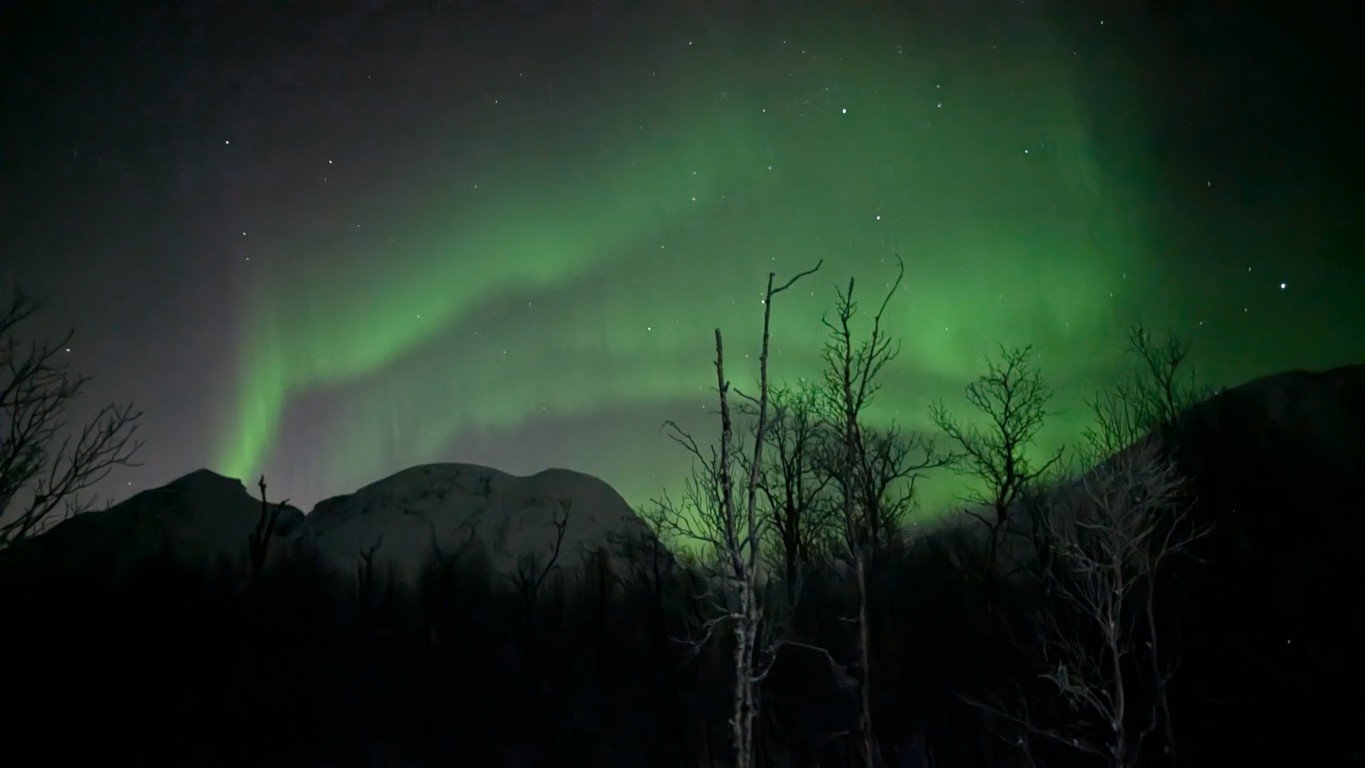
The Northern Lights, scientifically known as Aurora Borealis , are among the most impressive celestial phenomena on Earth. They occur when electrically charged particles from the solar wind are guided into the atmosphere along magnetic field lines and collide with oxygen and nitrogen atoms. At altitudes of around 100 to 300 kilometers, these gases begin to glow – usually in intense green, sometimes also in shades of red or violet.
The dancing lights are particularly common in the northern latitudes of Scandinavia, Finland, and Iceland. There, they appear as luminous arcs, flickering curtains, or pulsating veils in the sky. What is now physically explainable was for millennia a mysterious sign in the firmament – and was imbued with spiritual meaning in many cultures.
Myths of the Sami – Awe under the Northern Lights
For the indigenous Sami people, the Northern Lights were far more than a natural phenomenon. In the Arctic landscape of Lapland, where long winters and darkness define daily life, the aurora borealis was considered a powerful, awe-inspiring sight. It was not something to be admired or even celebrated – but rather something to be approached with seriousness.
In many traditions, the lights were interpreted as the souls of the deceased. It was believed that the spirits of ancestors were visible in the sky, or that they were the souls of those who had died a violent death. The flickering, sometimes restless glow appeared as a movement of these spiritual beings across the firmament.
Strict rules of conduct were associated with the Northern Lights. Whistling, speaking loudly, or pointing at the phenomenon was considered dangerous. According to traditional beliefs, anyone who mocked or provoked the lights risked attracting their attention. In some tales, the lights could descend, carry people away, or harm them. Parents earnestly warned their children against mischief under the Northern Lights – a mixture of spiritual respect and educational caution.
Especially red auroras were considered ominous. They were associated with blood, war, or disease and could be interpreted as omens of coming events. The rare, intense coloration lent the sky a menacing symbolism.
Other traditions tell of the lights as celestial beings playing with a skull or a ball – a motif that reflects the close connection of the Sami to hunting and reindeer herding culture. The sky was not understood as a distant universe, but as an extension of the earthly world, where similar forces and beings are at work.
The central element was always silence. When the lights appeared, people remained quiet, spoke softly, or withdrew. The Northern Lights were an expression of a spiritual worldview in which nature and the cosmos are alive and imbued with spirit.
Thus, in the cultural memory of the Sami, the Northern Lights still represent the presence of the invisible – a luminous band between earth, ancestral world and sky.
Light Gallery cannot find your image path: images/unterwegs/202602northern!