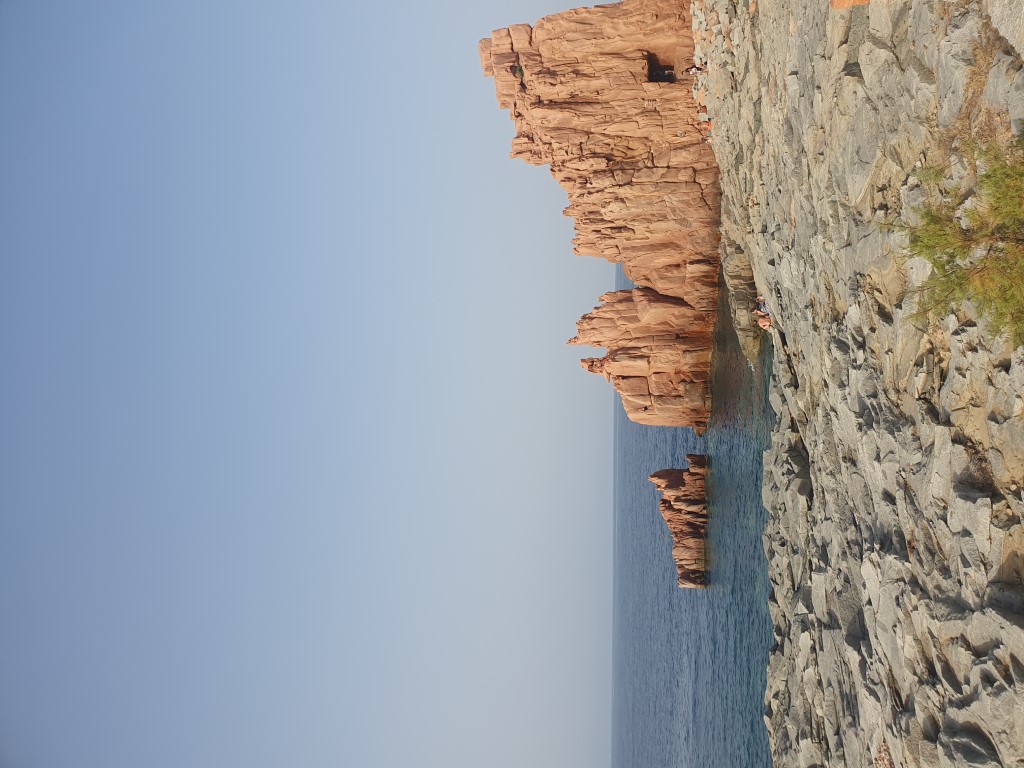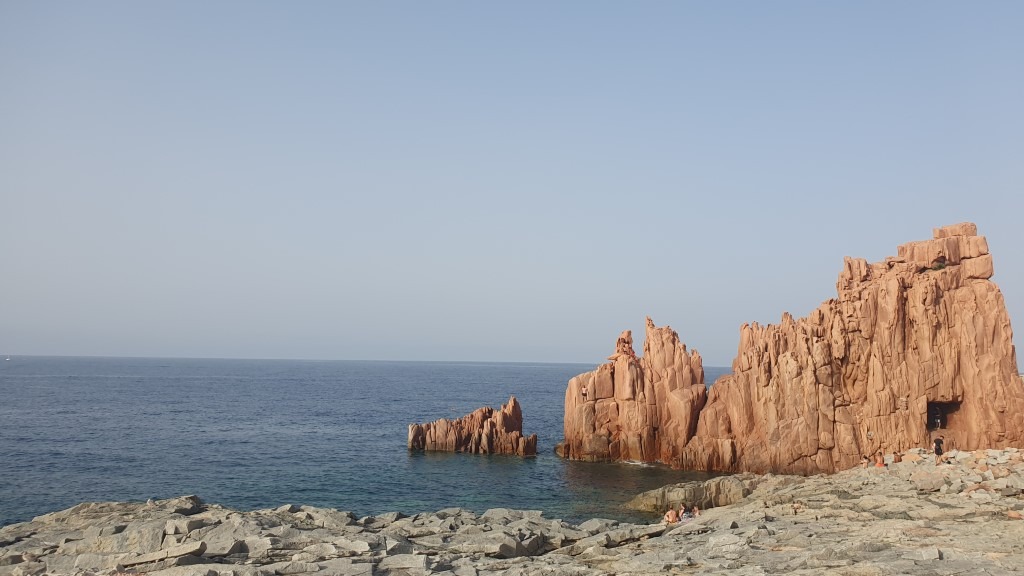
There are places in this world that seem as if they were painted by a dreamer—with a palette of lava glow and the scent of the sea, of the song of the wind and ancient rocks. In Ogliastra, on the central-eastern coast of Sardinia, such a wonder unfolds: the Baia delle Rocce Rosse, the Bay of the Red Rocks—a natural cathedral, built not by human hands, but by time, storms, and sunlight.
Here, just east of the small harbor of Arbatax, a charming district of Tortolì, a structure rises from the emerald-green waters, resembling an archaic monument. Porphyry-red, the rocks rise skyward, angular yet elegant, a work of the elements that stands in dramatic contrast to the white rocks and colorful pebbles on the seabed. The view takes your breath away – a play of colors between fire and water, earth and sky.
This rock formation is more than a natural phenomenon—it's a living sculpture, whose reflection paints the sea with shimmering shades of green and turquoise. It was not for nothing that director Lina Wertmüller chose this setting for the final scene of her legendary film Travolti da un insolito destino (1974). Here, where the light dances with the rock, cinema became reality, and reality became a narrative that is indelibly etched in the memory.
But the Rocce Rosse are not alone. The entire Ogliastra coastline is dotted with similar natural gems. Particularly impressive are the Is Scoglius Arrubius, two red rock towers, each 20 meters high, rising like stone sentinels from the waters of the nearby Spiaggia di Cea. Their presence is so iconic that they have become the symbol of this beach – a place where nature displays its most vibrant colors and every wave is a mini-hymn to beauty.
Those who come here leave everyday life behind and immerse themselves in a Sardinia that seems unspoiled, sensual, and almost unreal. The Baia delle Rocce Rosse is not just a destination – it is an experience, a meditation, a poem in stone and salt.
And who knows – maybe the wind between the rocks will whisper the next great story into the ear of one or another visitor.