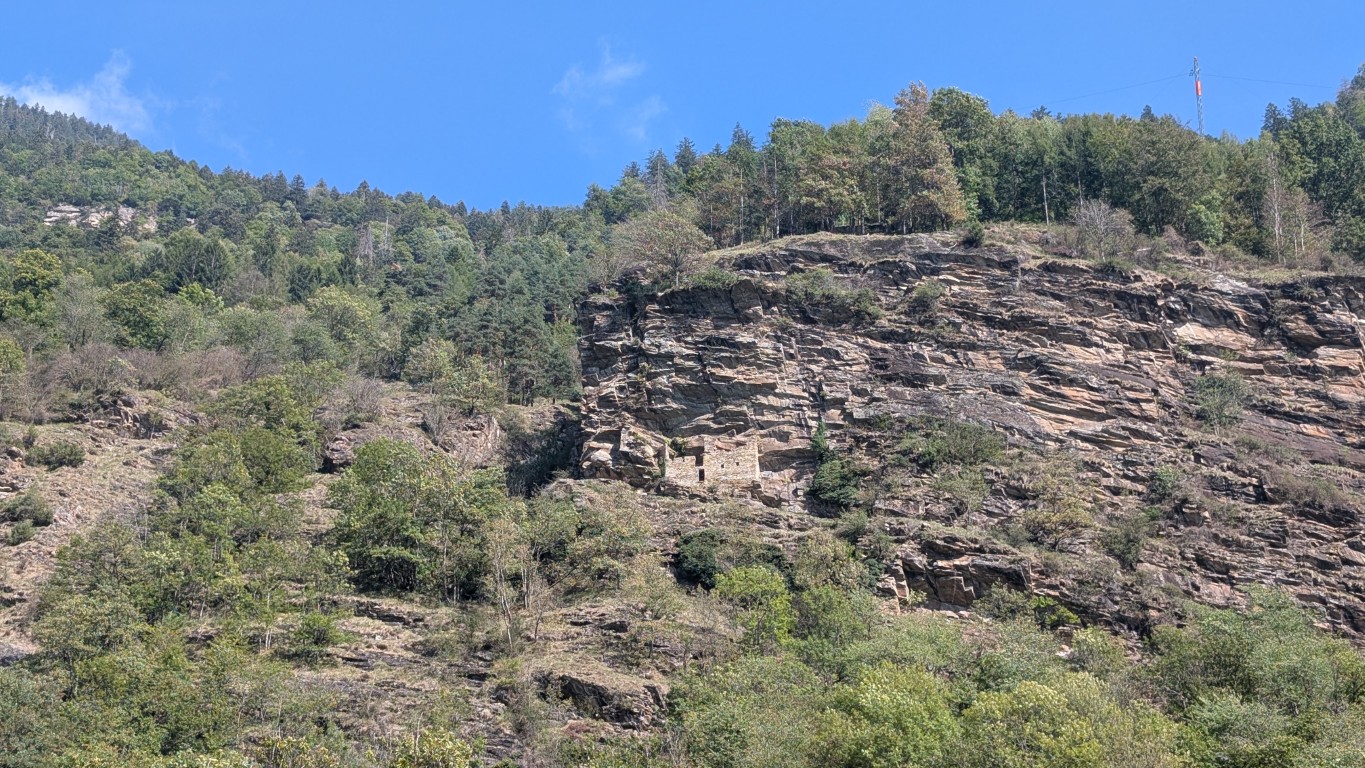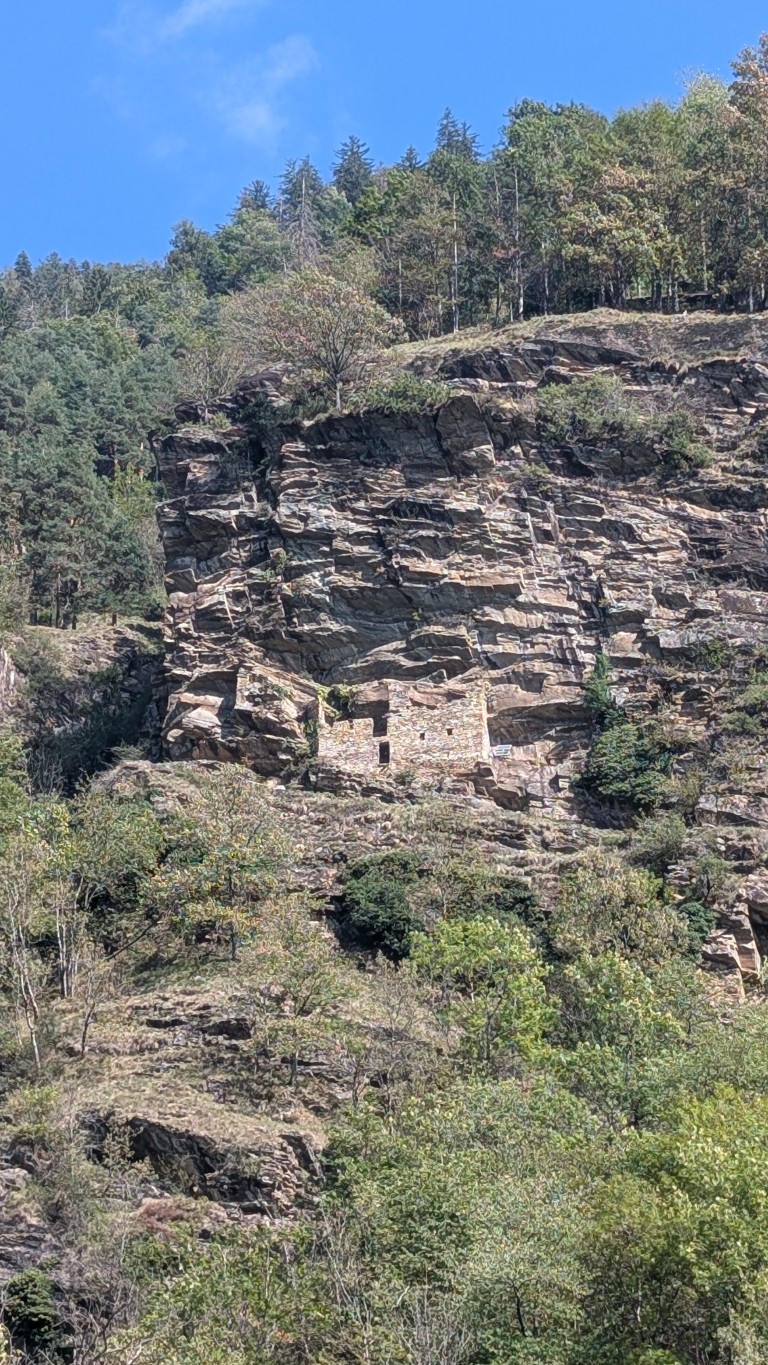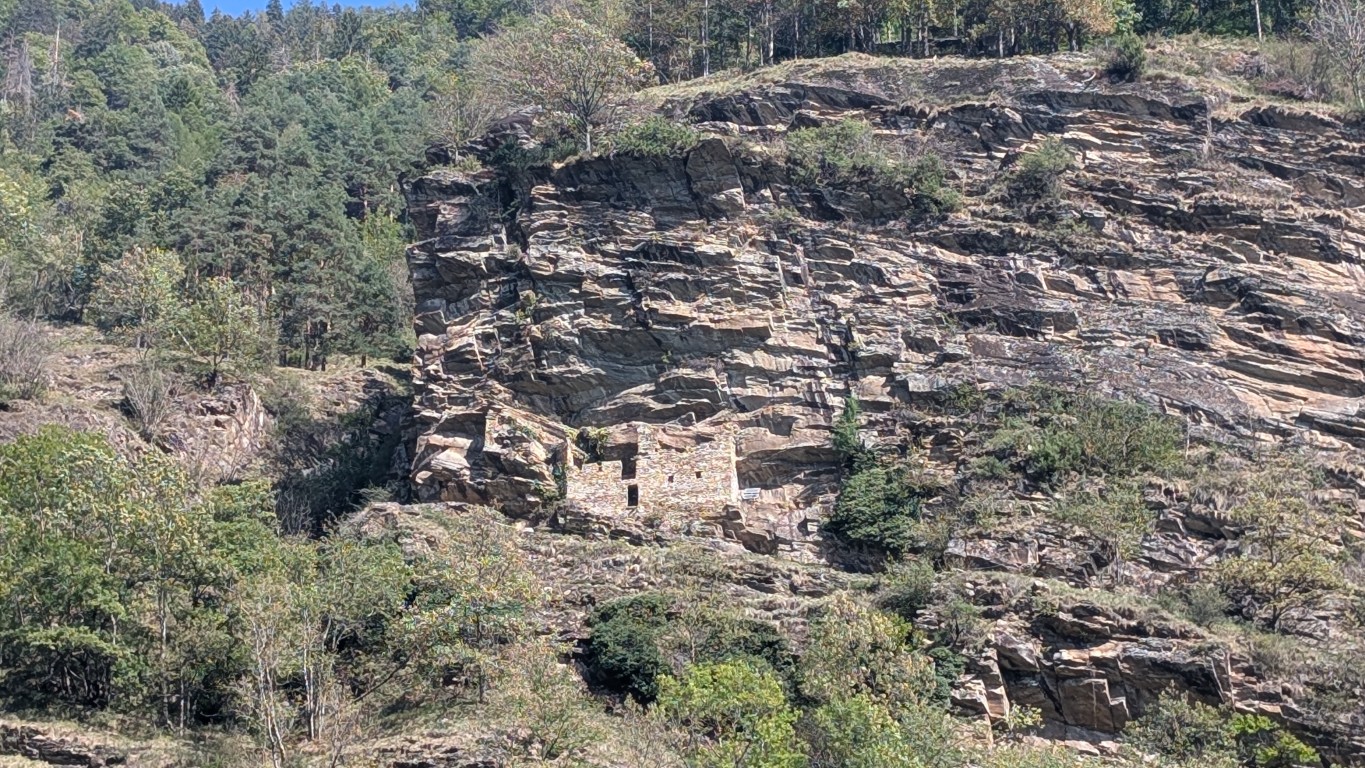
Deep in the Blenio Valley, high up on steep rock faces, lie some of Ticino's most mysterious structures: the Case dei Pagani , the so-called pagan houses. Anyone discovering them for the first time inevitably wonders how people came up with the idea of building houses and small castles in such places.
The answer likely lies in a time when safety was more important than convenience. The medieval fortifications were built on barely accessible rocky outcrops and under natural rock overhangs. Ladders, wooden walkways, and narrow ledges served as access points.
Houses high above the valley
The Case dei Pagani are not a single castle, but a group of small medieval fortifications. Most are located in the Blenio Valley, including above Aquila, Marolta, Dongio, Olivone, Dangio, and Malvaglia.
Their current name, however, is more recent than the buildings themselves. Because there were no written records of their origin and the houses were located in mysterious, almost inaccessible places, numerous explanations arose over the centuries.
It was said that pagans, witches, or demons had once lived here. Other stories described the sites as hideouts of Saracens, prisons for witches, accommodations for lepers, or robbers' dens.
Today, however, historians and architectural researchers assume a much more sober explanation: The Case dei Pagani were probably small castle complexes built by local nobles and used as places of refuge in uncertain times.
The Legend of the Pagan Houses
Precisely because no one knew exactly who had erected these unusual buildings, the imagination of the population could unfold all the more strongly.
One particularly mysterious belief was that after the Christianization of the valley, the last followers of old religions had fled to the remote rocks. There, far from the villages and churches, they had preserved their old customs.
Thus, the lonely rocks became places of mystery. If a fire was seen high up in the rocks at night, or a sound came from the dark gorges, talk quickly turned to heathens , witches, or the Wild Man.
The name Case dei Cröisc – meaning “Wild Man Houses” – also recalls these ideas.
Whether people adhering to pre-Christian religions ever actually hid there is unproven. However, the legend reveals something important about the perception of these places: For the people in the valley, the mysterious houses high above their heads were for a long time a place that was explained more through stories than through history.
The Casa dei Pagani of Dongio
The Casa dei Pagani in Dongio is particularly impressive. Located at an altitude of approximately 620 meters in a natural semi-cave high above the village cemetery, it is considered the most completely preserved cave castle in Ticino. Carbon-14 dating indicates that it was built between the 9th and 11th centuries.
The approach was anything but comfortable. A steep forest path leads uphill, followed by a narrow ledge. The actual entrance to the castle is only accessible via a secured climbing route.
The building was originally about 14 meters long and had several stories. Three stories still remain today. Hearths, structural details, and finds show that people actually lived here.
It was probably a small noble castle and refuge. The complex was likely abandoned in the 15th century.
A castle without a castle hill
What's fascinating about the pagan houses is their unusual architecture. Instead of being built on a hill, they stand where nature had already created a fortress: under overhanging rocks, in caves, and on narrow ledges.
The walls therefore didn't need to be particularly thick. The natural location made an attack difficult anyway. Ladders and wooden walkways could be removed in an emergency – and anyone wanting to reach the castle first had to work their way up steep rock faces.
The Casa dei Pagani in Malvaglia particularly highlights this extreme location. The complex sits high above the village, nestled in an almost vertical rock face. Access was via a narrow ledge of rock, in some places only a few centimeters wide.
What's really behind the secret?
Archaeological investigations have now solved many mysteries. The finds show that the inhabitants were by no means primitive hermits. In Malvaglia, for example, jewelry, coins, a precision scale, and other objects were found that point to inhabitants of a higher social status.
The dating of the sites also tells a fascinating story. Some of the structures originated as early as the Early Middle Ages. The oldest dating for the Casa de Malvaglia even extends back to the 3rd to 7th centuries, while the Dongio I site is dated to the 9th to 11th centuries.
This transforms the supposed "heathen house" into a fascinating testament to medieval building and lifestyle.
An excursion for adventure seekers
Anyone venturing to explore the Case dei Pagani should bear in mind that not all of the sites are easily accessible. Some are located in extremely exposed positions and can only be entered safely with climbing equipment, or not at all.
That's precisely what makes them so appealing: the Heidenhäuser are not perfectly restored castles with towers and drawbridges. They are mysterious remnants of a long-gone world – hidden in the rocks and in some places almost completely reclaimed by nature.
Perhaps it is precisely this mixture of history and legend that gives it its special charm.
For when the light slowly disappears from the Blenio valley in the evening and the rock faces lie in shadow, one can easily imagine why people used to believe that something sinister was going on up there.
The Heidenhäuser are places where history and legend are particularly closely intertwined – and that is precisely why they are among the most mysterious cultural treasures of Ticino.